Be yourself; Everyone else is already taken.
— Oscar Wilde.
This is the first post on my new blog. I’m just getting this new blog going, so stay tuned for more. Subscribe below to get notified when I post new updates.
by Allie Anthony
Be yourself; Everyone else is already taken.
— Oscar Wilde.
This is the first post on my new blog. I’m just getting this new blog going, so stay tuned for more. Subscribe below to get notified when I post new updates.
The first thing I do when I start a new course is to check out the syllabus. I like to mark important dates on my calendar, see exactly what I’ll be learning, and look forward to exciting projects. When the syllabus for ASCJ-200 came out, I was thrilled to see that we were assigned a video remix project.
I have never been able to really work with video. In the past few years, I have done most of my story telling through writing and photography, so this was a task I was really looking forward to.

When the process of creating this video remix began, I was a little less excited, and a little more nervous. I had no idea what I wanted my video to be about, how I would make something that people would want to watch, and how I would convey a message without using my own writing or voice. Because of my concern towards these objectives, I decided the best way to make something powerful would be to brainstorm and to just start creating.
During my brainstorming period, I decided that doing a project over COVID-19 would be a way to challenge myself as a storyteller. The whole issue of the novel coronavirus is so new, so rampant, and so complex. These were all elements of the story, elements that I knew had to be shown in my project.
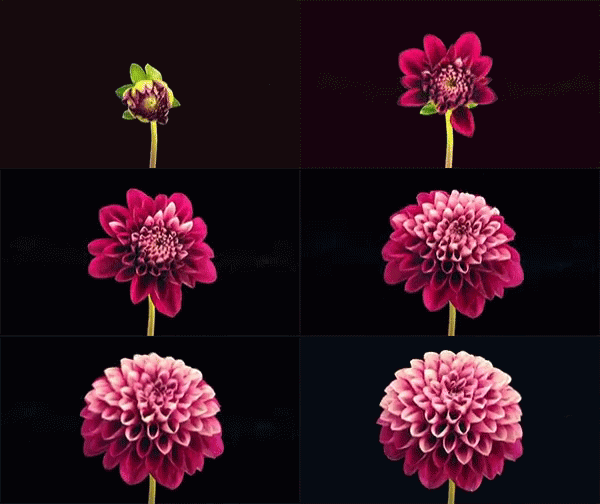
Initially, I thought I could follow the idea of the “misinformation surrounding coronavirus.” After some research, I became less thrilled with that idea, and more interested in seeing the ways that people were reacting to COVID-19 (most of them being anxious). This is where my idea for this video really blossomed.
Anxiety is something that has always been an outcome of global issues. Something interesting, however, is the amount of anxiety that COVID-19 has caused for people around the world. As my 87 year old grandmother puts it “I’ve never seen a damn thing like it.” The way that the media has presented this virus with so much fear and caution has created a world that now lives in complete fear. The anxiety of watching the news and hearing about lockdowns, loss of work, hungry people, and handling this virus is something that has saturated the world.
I want to mention that I am not promoting a world where we are not informed or concerned. This situation is terrible and is something we should all be educated on. However, I do find that the over consumption of media surrounding COVID-19 can be very hurtful to individuals. Although it is completely normal to feel afraid during these difficult times, I wanted this video to show how to remove yourself from the media at times when you just need to.
To convey this message, I broke my video into three core pieces. The first piece of the video displays how the media is constantly talking about COVID-19. This is almost designed to create a feeling of anxiety. The second part was put in to show how the overconsumption of news media is hurtful. This part of the video is practically my thesis for the entire project. The third piece of the video shows happy times at home, the goal of staying happy and healthy during this health crisis. Time spent with family, by yourself, on the phone, and dancing in your underwear may just be the thing that keeps you sane in this crazy time.

Youtube, Best Of – The Fresh Prince of Bel-Air
Youtube, Step Brothers Bunk Beds
Youtube, Sixteen Candles They Forgot My Birthday
Youtube, The Opening Monologue Ferris Bueller
Youtube, Home Alone Funny Scenes
Youtube, Reading is Fundamental Ad
Youtube, Watch Full Coronavirus Coverage NBC News
Youtube, WATCH LIVE: Get coronavirus updates in special ABC7 digital newscast now
In March of 2018, the world of social media and security collided as the Cambridge Analytica scandal broke out. When Facebook illegally sent millions of user’s information to a political data-analytics firm (Cambridge Analytica), political campaigns were able to charge themselves towards different groups of people on social media. As expected, there was a pretty good amount of public outrage as a result of this scandal and social media hasn’t been the same since.
While most people associate data collection with Facebook or with Google, it’s pretty important to understand that most first-party apps are also collecting their users’ data.
The dating app Bumble is a great example of how first-party apps collect data. While most college students know Bumble from its extravagant advertising and its popularity, there is more to this app than finding ~virtual romance~.
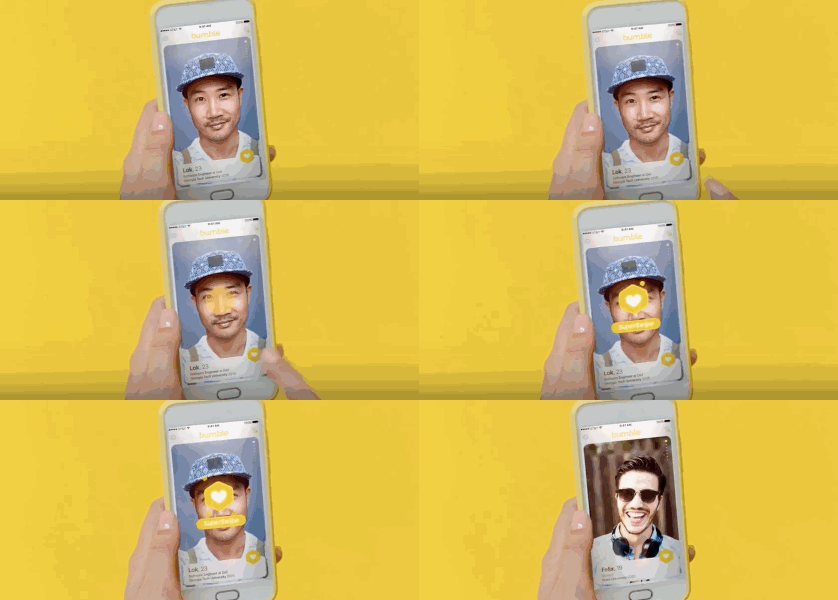
First of all, Bumble collects a good amount of data just from their app. Bumble knows who you are, where you are, how old you are, your sexual preference, what you look like, and sometimes where you go to school or work. This about covers it all, right?
No, it doesn’t. Bumble can take its data collection even further through third-party apps and accounts. When users sign up, Bumble gives them the option to connect to their accounts on Facebook, Google, Apple, Twitter, etc. In this case, these accounts are known as third-party apps. By connecting to these apps, Bumble now has loads of information on their users that can go much further than the information previously listed.

So, what is the point of all this? For most apps and media sources, the economic incentive behind data collection is to market to a user’s demographics directly. For example, Bumble can use the information they have to send out specific ads to users as they swipe through. The company that pays Bumble to prompt their ads wants a specific clientele, and through data collections, Bumble can provide that. This gives apps and media sources the power to take data, and sell it. These direct and convoluted advertisements essentially cheat for different companies and apps.
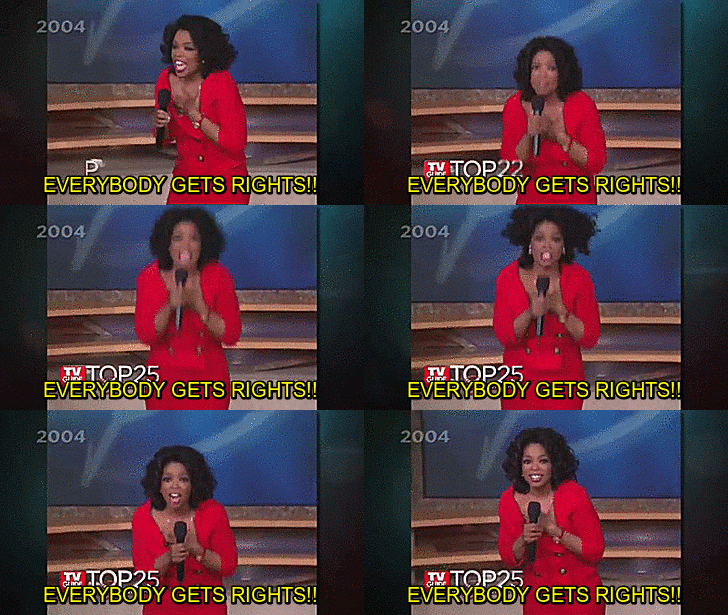
On the other hand, the user is also affected by data collection. Whether its an ad for a new car or a political post, we have all been affected by data collection in one form of media or another. While these ads are sometimes helpful (i.e. when you finally find that perfect white t-shirt from an Instagram ad), there are many times when these ads are unwanted/ hurtful. This is exactly why Facebook and Cambridge Analytica were under so much fire. Because of the way that certain advertisements or posts have the power to influence our opinions, social media users must understand the right to privacy. Although these rights are weak in the world of social media, they still exist and must be taken more seriously. By implementing new laws regarding clarity and self-protection, we may be able to find a balance between over/under data collection.
Finally, our society must take action toward the over-collection of personal data. We need to address the question of how far is too far when it comes to personal information stored in media sources.
During my time spent alone in quarantine, I feel like I habe constantly been online. From Instagram, to facetime, to google docs, my world has become more virtual than ever. In this new virtual life that I have been living over the past four weeks, I have also started to use social media in more ways than one. While I typically use Instagram to check out photos of my friends, it has recently become one of my primary outlets for socializing, news consumption, inspiration, and comedy. While I used to separate my news feed from my social feed, they have collided into one through the use of Instagram.
Throughout these past weeks, Instagram has been my source of comedy, social security, and stories. For example, every meme account I follow has seemed to add some comic relief to the current state of the world. Although satirical, these memes feel relatable and help me to remember that we are all lonely together.
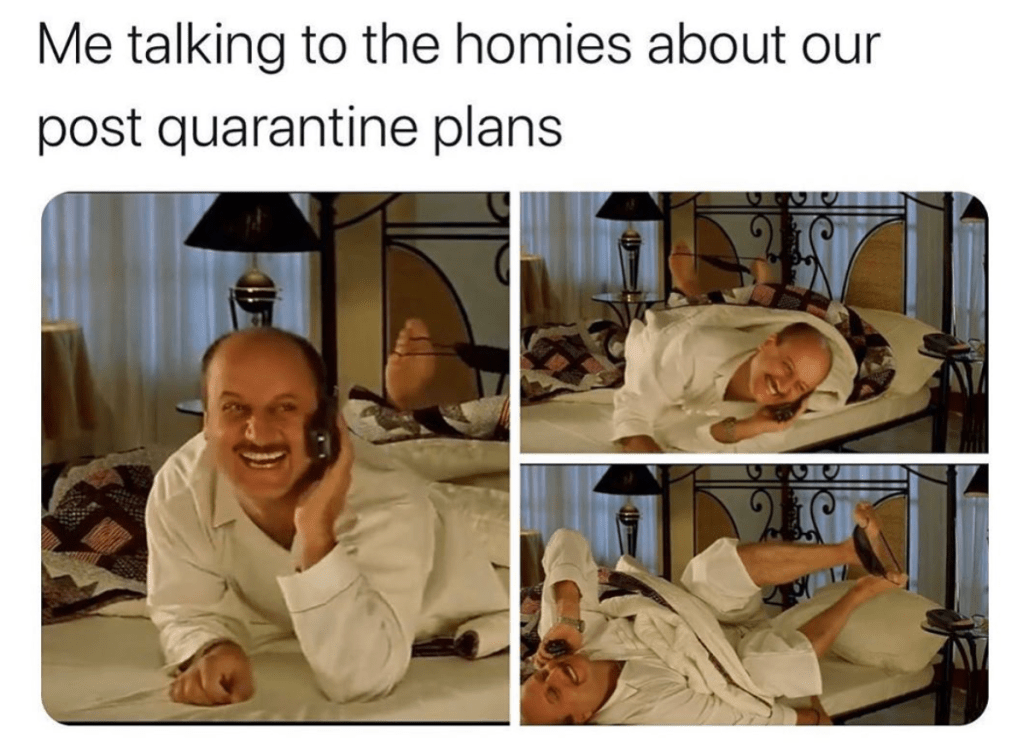
Instagram has also helped me to stay connected to friends and family. Through the direct message function, I communicate with others by sending/receiving news, memes, photos, etc. When I send/reciceve messages on Instagram, there is almost a more special connection to the people that I am communicating with because I know they are watching or viewing the same crap as I am. Again, this reminds me of how we are all lonely together.
One of my favorite ways that Instagram has been helpful during these weeks is through motivational stories. Although hard news is always important to pay attention to, I find myself always more intrigued with the personal stories about different people during this era. By hearing about the COVID-19 survior, seeing nurses be superheros, or watching a family singing Happy Birthday to their grandfather through a window, I am more able to block out the negative views of the world’s current situation and see the amazing things that people are doing to help and lift eachother.
View this post on InstagramThis COVID-19 patient was cheered on by medical staff after recovering from 10 days on a ventilator
A post shared by NowThis (@nowthisnews) on
Although over consumption typically leaves me feeling insecure, unmotivated, or lonely, my consumption of media over these past few weeks has almost felt like a saving grace. I think I feel this way because of the type of media that I am consuming. Instead of looking for negative things, I have restircted myself from the hard news, and let myself see my friends, laugh a little, and read uplifiting stories. While I still find importance in the education surrounding COVID-19, I find that I keep myself in a happier state of mind when I only allow myself to read the reality of this sitaution for a certian amount of time. While different forms of media affect different types of people, I believe that there is a real importance in finding out how we each react to different things, espically in such hard times.
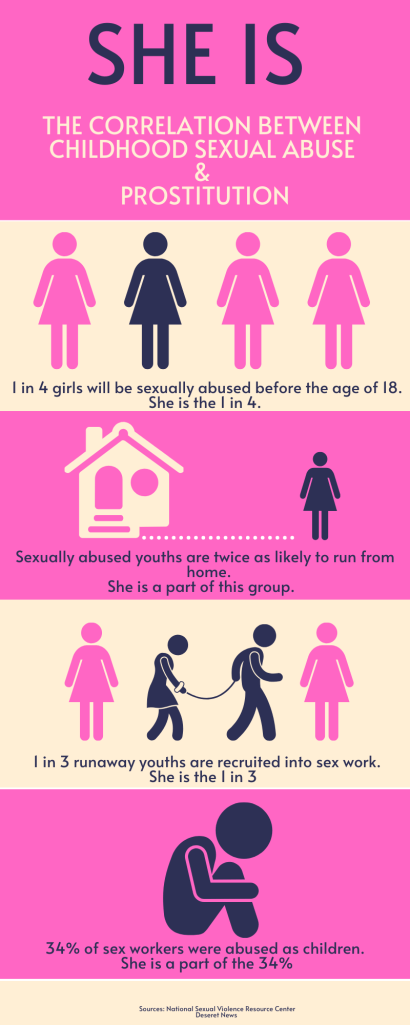
Sex trafficking prevention is something that I have been passionate about for many years. I believe this intrest began due to the certian complexity surrounding the world of sex trafficking. I really wanted to understand this issue so that one day I could become educated enough about the topic to help rehabilitate and provide justice for victims. After spending two years of high school studying this topic through multiple perspectives, I found myself in the position to engage in conversations and provide insight in relation to this issue. In my first year of college, I have continued to find ways to engage in the freedom of sex trafficking victims and learn about the lives that they endure.
When I found out that we had to create an infographic I was eager to make something regarding the incarceration rates of sex trafficking victims. This was just complex enough to be visualized into a graphic. However, when we were given the list of topics for this project I was stumped. I needed to find a new way to demostate the issues surrounding sex trafficking within the guidelines of the project at hand.
After thoroughly thinking through both ideas of homelessness and sexual assult, I decided the most intrested and effective graphic I could make would be how child sexual abuse and sex trafficking correlate. I have researched this correlation in the past, and I found the statistics shocking and incredibly underrepresented. These two elements are really the reason why I choose this topic. I wanted to be able to create something visually appealing that also could inform people about this humongous issue that could be happening right in front of their eyes.
As I searched for statistics to help testify to this correlation, I wanted to find a flow in facts. This meant taking the viewer through the life of a victim of both childhood sexual abuse and sex trafficking. The infographic begins at the beginning of the story, where the issue at hand seems distant. The further you read however, all of the facts come together and make a more personal and significant story.
The design of this project was really based on legibility and commonality. I wanted this infographic to be easy to read, yet powerful. I didn’t want huge clumps of words or complex images. I simply wanted it to be user friendly so that this deep message could be spread more easily.
Essentially, I wanted to create this infographic so that people could become more educated on the issues that childhood abuse can bring. While my passion project lays more into the world of sex trafficking victimization, childhood sexual abuse is a key contributer to the entrance of victimization. While there may not be a “silver bullet solution to sex trafficking” it is essential that our society opens our eyes to the issue so that we can each be resources for victims when they are in abusive or manipulative situations (Anderson 2015). Hopefully, this graphic is something that inspires you to understand and to create awareness towards each of these issues.
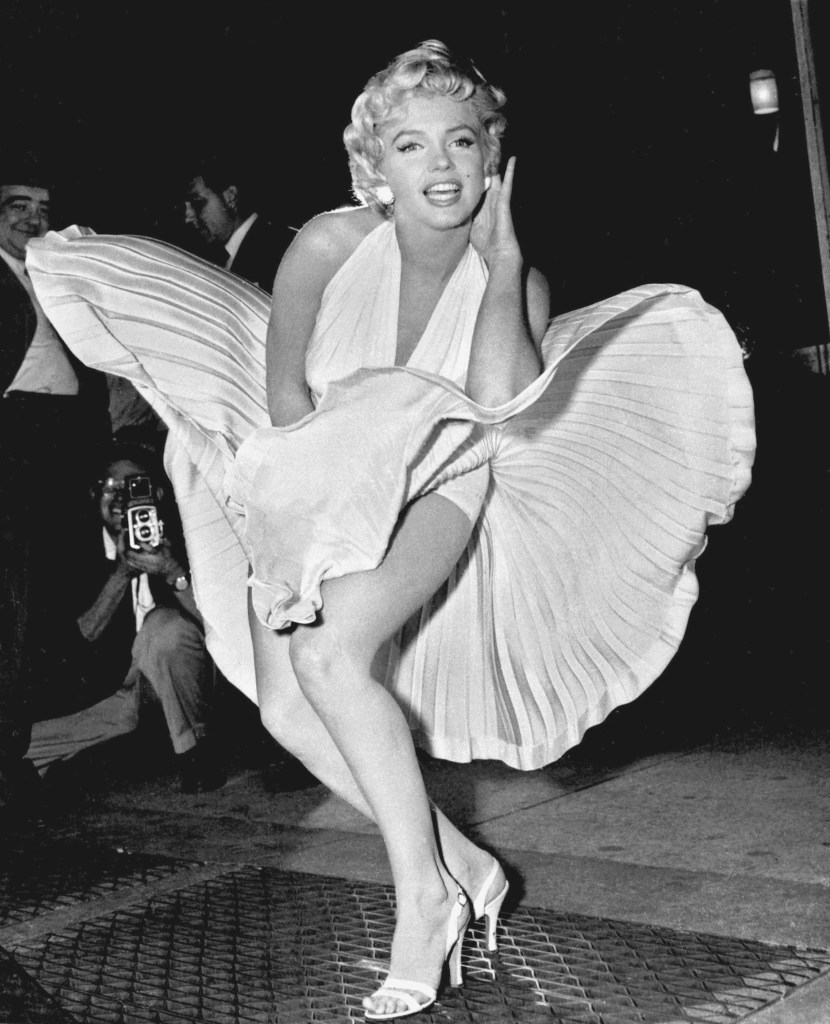
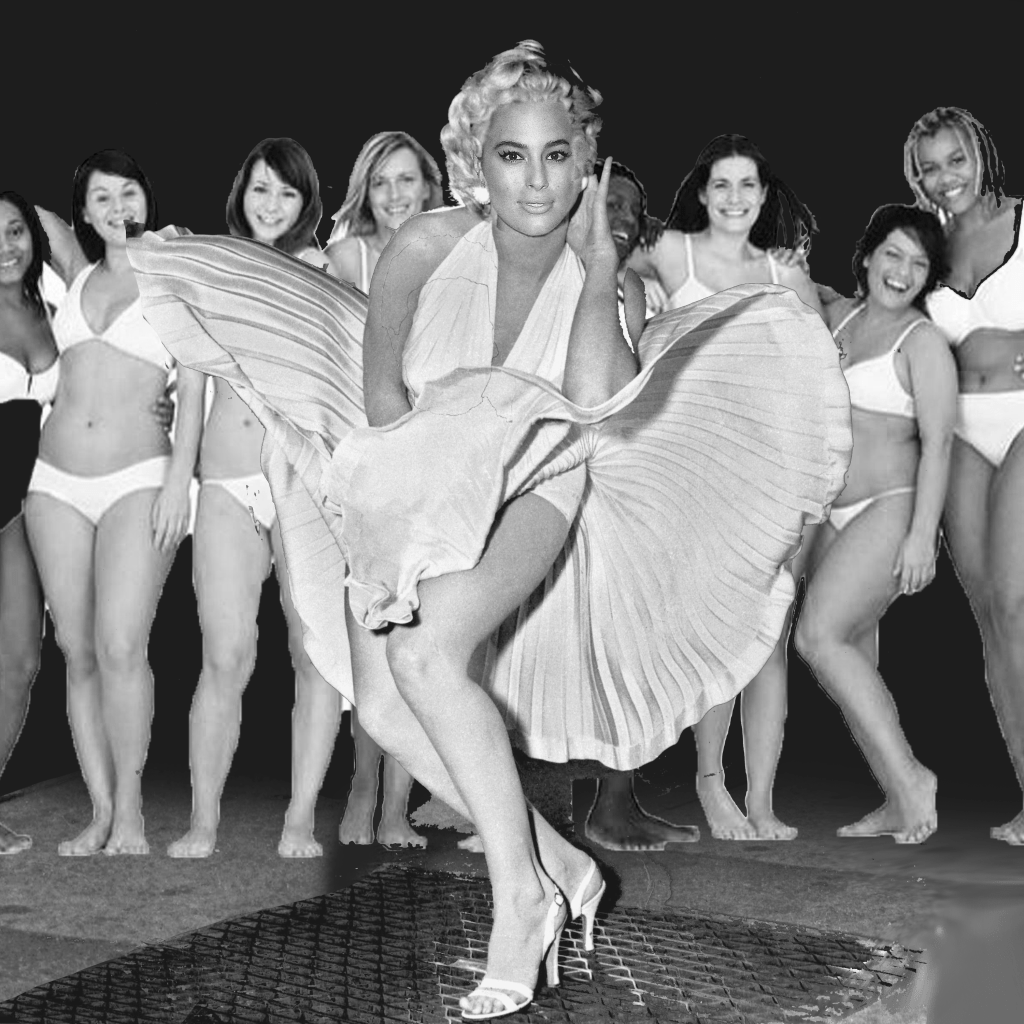
Marilyn Monroe: She’s the face of femintity, beauty, and sex. She broke barriers, shaped the thoughts of body confidence, and shifted ideas of femininity. No other photo but the iconic “Seven Year Itch” image shows these traits. After being assigned a photo alteration, I knew I wanted to use this image to not only show how far women have come in the areas of self confidence, but to also show how far we still must go. To do this, I swapped the muse, Marilyn Monroe with my own muse, Ashley Graham. While Monroe broke standards in the 50s and 60s, Graham is breaking the femine standards of 2020. As a plus sized model, Graham shows that beauty and confidence can come in any shape or size. I love this alteration because both of these icons show us how self confidence is beautiful. This is a lesson that women of every decade struggle with, and that’s why this alteration is meaningful. Another alteration I made was the deletion of the paparazzi in the original photo and the addition of the body confidence dove campaign of different women with various appearances. This deletion and addition is important to the alteration because it shows an army of women who are self loving. With all of these adjustments, the new image could display how body and self confidence were one beautiful and still are. The more that society sees women in a confident, self loving light, the more accepted women will feel, regardless of their appearance.
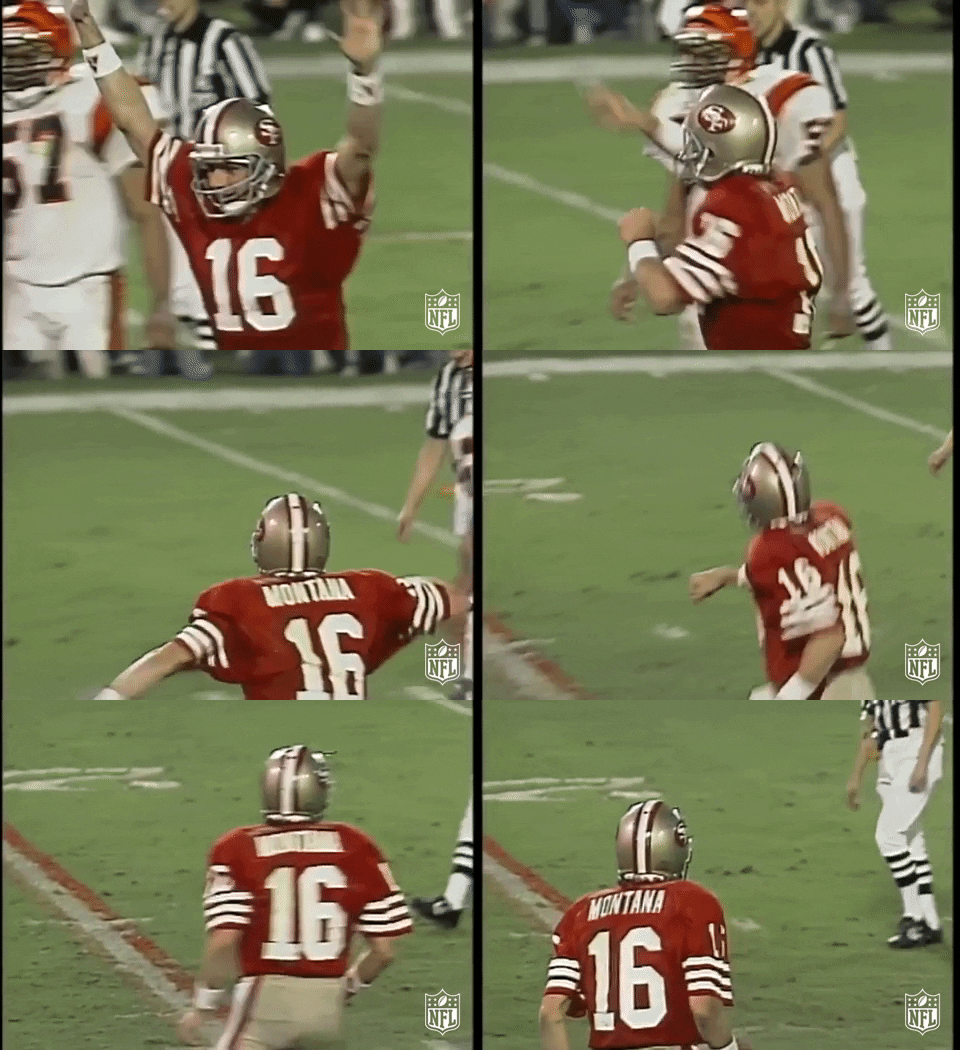
Patterns break and as for the 2019 San Francisco 49ers, this reigns true. In Grant Gordon’s article “These Niners look a lot like ’94 Super Bowl champs,” similarities between the 1994 and the 2019 Niners are made and lead to the idea that in Super Bowl LIV, the 49ers had a shot to win against the Kansas City Chiefs. As of Sunday night however, it’s evident that history was not bound to repeat itself. With this being said, it is logical to suggest that Gordon had a secret motive behind his article? A desire to pull at the heart strings of football super fans? After analyzing his message, it’s fair to say that he had no intentions but to spread interesting information with the readers of NFL.com.
The first step I took while analyzing this article was to consider the source. First of all, the author, Grant Gordon, has worked for multiple different press companies in sports editor and writer positions. He posts on a daily basis while maintaining a reputable name in the sports industry. The sources mentioned in this article lacked. Although facts were embedded into the text, citations were not available.
Although these sources were not cited, I did find that the proximity to this story did help Gordon’s case. While mthis writer probably wasn’t as present in the 1994 Super Bowl as he was in the 2020 Super Bowl, he does have credibility in the world of football. As a daily writer, he is up to speed with what is happening in the league. In addition to this, he quotes 49ers QB Jimmy Garoppolo directly. This adds a sense of credibility.
Another reason why I trust this article is because Grant Gordon, and all of the writers on NFL.com, are fairly independent and have standards to uphold. While each particular writer for NFL.com may have a personal bias as to which teams they support, I believe that this media source does a nice job at balancing coverage between teams. The result of unbiased writing comes from this media source’s necessity of expertise. For example, as an expert in football, Gordon is able to write with accuracy and through a nonpartisan lens.
After looking through Gordon’s twitter, I noticed that he appears to have zero biases when it comes to NFL teams. After the Chief’s took the championship on Sunday night, Gordon tweeted posts congratulating the Chief’s on their victory. This speaks volumes when it comes to the motivation behind this article. I don’t think Gordon was trying to coax anyone to bet on or to root for the Niners. I believe that he simply found correlational information that created a quite interesting article. The motive behind this story was to show that the 1994 Super Bowl Champion team and the 2019 49ers are two similar teams, thus creating an interesting twist on the story behind the 2020 Super Bowl.
Although I enjoyed this story, the evidence should have been pronounced much more clearly. This article is written by NFL.com and strictly mentions NFL stats and facts, but there is only one time a source is mentioned (that source being the NFL). Personally, this does not come off as inaccurate news, but as poor judgement of the writer. It’s hard to exaggerate or skew facts such as who coached a team, which round draft picks were in, and season records, but Gordon still should have clarified the information which he provided.
Gordon’s article had some amazing correlational information, however I did think that some facts were over-generalized. Yes, both teams had some free agent players on their roster, but that occurs on every NFL team. Essentially, some of the facts mentioned were not as noteworthy as others.
I don’t find that anything is left out because this story is facts that are strung together and connected. To grind the story down to the core, you could say that some of the differences between the 1994 49ers and the 2019 49ers were omitted however, I don’t think that anything is being marginalized in this piece.
Overall, I think that Gordon made a strong comparative piece that was able to grip me into reading more. While there are some logical and evidential changes that could be made, this article sits well with the reader. Because football is less controversial than other news, Gordon’s story would most likely come off as captivating and well written to the average reader. All in all, it’s a shame those Niners weren’t victorious this year.
Lexi: “Do you want to grab some dinner?”
Me: “Yeah, I know, right.”
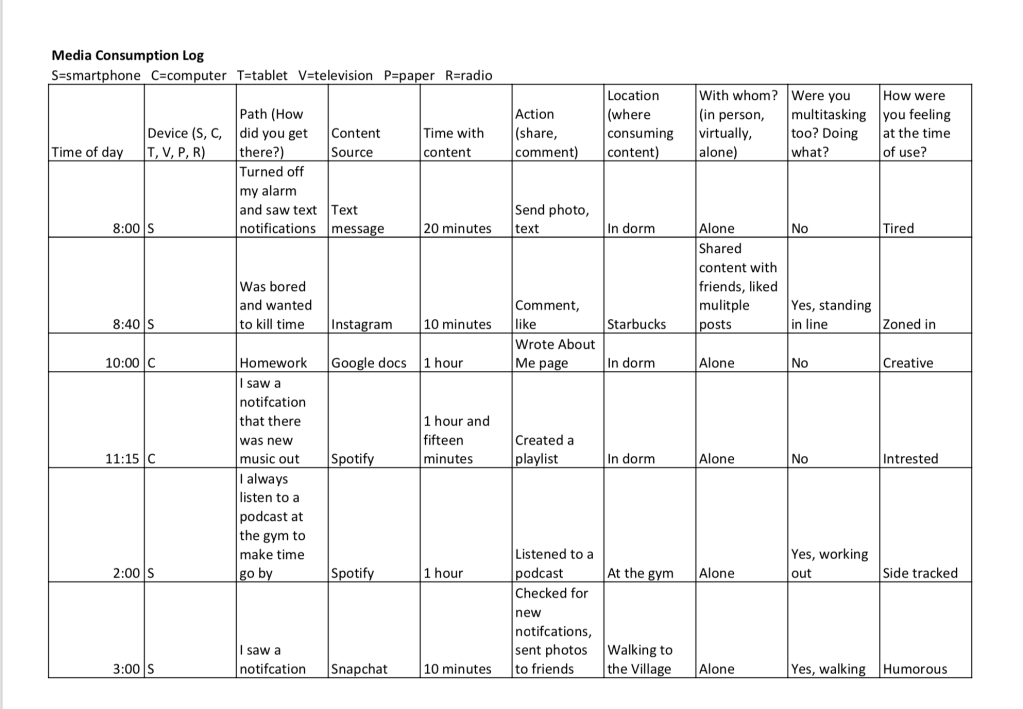
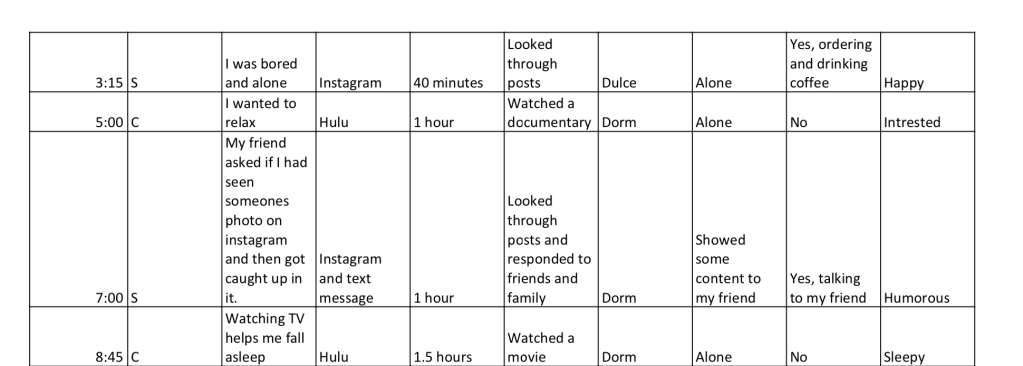
I am insanely unskilled in the realm of multi-tasking. I can’t pat my head and rub my tummy or follow directions and write at the same time. In the age of social media, this is a huge issue. Between hitting up the gram, checking my snaps, reading captions, and watching tv shows, I believe I have missed a lot of the things that have happened around me (especially because I can’t comprehend real life things if I am also looking at my phone). This was something I knew I’ve struggled with, but after being asked to record my media habits I have really come to understand the grand issue which is social media addiction in combination with lack of focus.

Over the 24 hours of which I was asked to record my media habits, I noticed a trend of unfulfilling real world experiences. For example, as I scrolled through Instagram while standing in line to get a coffee at Starbucks yesterday morning, I didn’t take the time to say hello to the people around me or get to genuinely thank the barista who makes my cold brew every morning. Because I was so caught up in what my instagram showed, I didn’t seem to care about the real world.
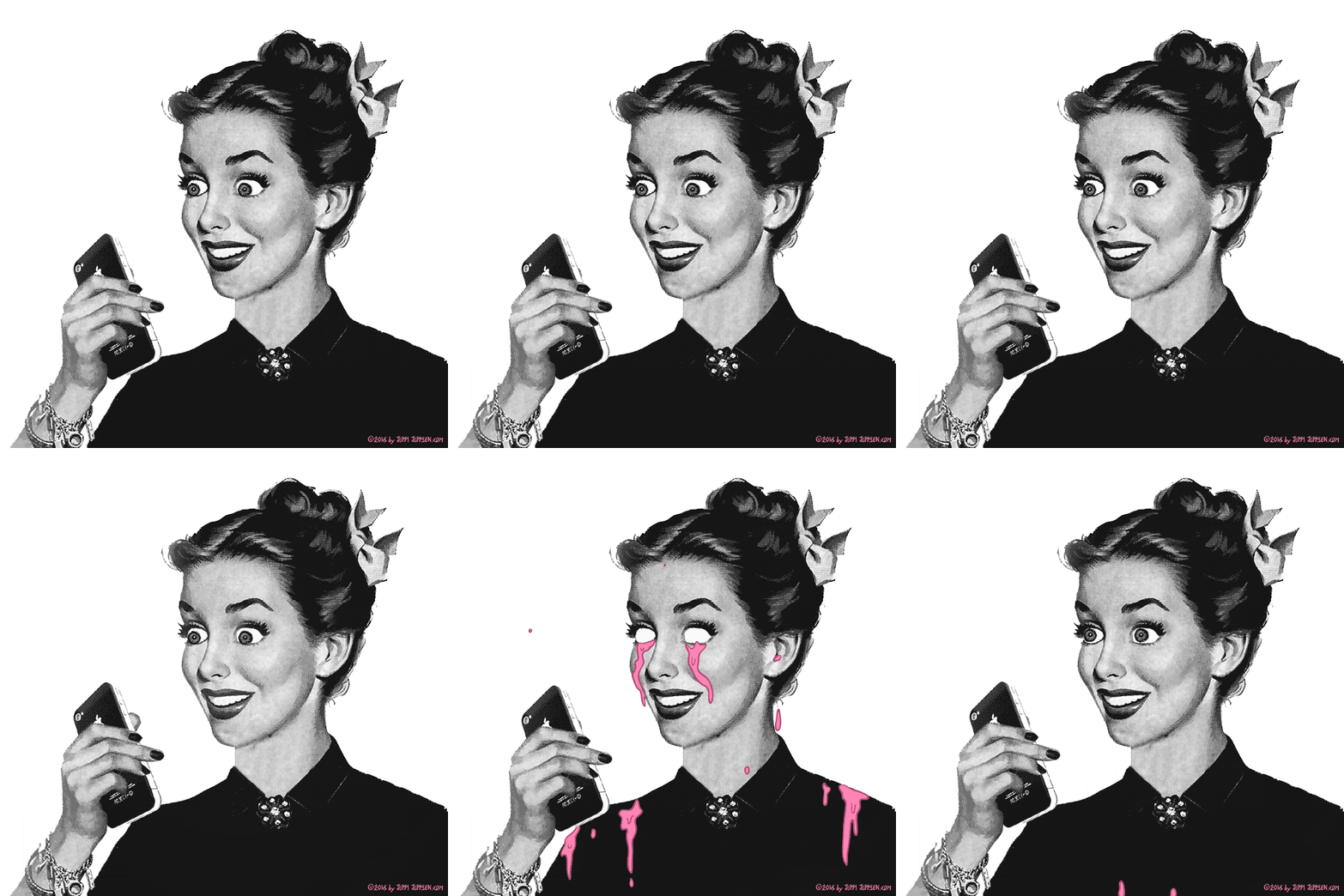
Even though I could probably be using social media and the world wide web to find out interesting facts, get deep into the news, or solve deep issues, I really just looked at photos of puppies, memes, my friends, and news of low personal importance. I noticed that with all of the hours I spend on my phone and laptop, I really just use these devices as an escape from reality. It’s much easier to pick up your phone and check up on Kim Kardashian’s whereabouts than to pull up CNN on your laptop and read about politics (well, at least for me it is). This is something that makes me inspired to make more conscious choices as I consume media. Instead of dumbing myself down, I want to start looking for real, interesting, and important content.
How will I do this? Well, for starters, I’ve decided to leave my phone out of sight during the day. Instead of placing it on my desk or holding it in my hands, I’m going to leave it in my backpack (or maybe even just leave it at home- power move). When I check my phone however, I want to really attempt to consciously make choices. I’m challenging myself to consider how social media will affect my mental health, how news will sway my opinions, and how instant gratification creates issues in the real world. By doing these things, I feel as though I will be able to have a better appreciation for not only media consumption, but for life. In 2020, it’s quite easy to forget what the real world is, who lives in it, what true feelings are, and what living boldly is all about. Through these practices, I sure as hell hope to come out on the other side and smell the roses.

This is an example post, originally published as part of Blogging University. Enroll in one of our ten programs, and start your blog right.
You’re going to publish a post today. Don’t worry about how your blog looks. Don’t worry if you haven’t given it a name yet, or you’re feeling overwhelmed. Just click the “New Post” button, and tell us why you’re here.
Why do this?
The post can be short or long, a personal intro to your life or a bloggy mission statement, a manifesto for the future or a simple outline of your the types of things you hope to publish.
To help you get started, here are a few questions:
You’re not locked into any of this; one of the wonderful things about blogs is how they constantly evolve as we learn, grow, and interact with one another — but it’s good to know where and why you started, and articulating your goals may just give you a few other post ideas.
Can’t think how to get started? Just write the first thing that pops into your head. Anne Lamott, author of a book on writing we love, says that you need to give yourself permission to write a “crappy first draft”. Anne makes a great point — just start writing, and worry about editing it later.
When you’re ready to publish, give your post three to five tags that describe your blog’s focus — writing, photography, fiction, parenting, food, cars, movies, sports, whatever. These tags will help others who care about your topics find you in the Reader. Make sure one of the tags is “zerotohero,” so other new bloggers can find you, too.



 WHO WE ARE